
★★★★★
Component Two · Up to 100 Points

The HR Assessment: 39 Criteria, Backed by Evidence

In the HR assessment, your HR team or management answers 39 criteria in eight areas online, usually in less than an hour. Each answer earns points only as far as documents and independent checks support it.

Human scoringSecond independent reviewNot a legal audit
100points8 areas · 39 criteria
A12 ptsB15 ptsC15 ptsD12 ptsE18 ptsF12 ptsG8 ptsH8 pts
39criteria
8areas
100points
< 1 hto complete
2human reviewers

The process

Five Steps From Answers to Points

1

Digital questionnaire

An authorized representative answers all 39 criteria with Yes, No, In progress or Not applicable and a short explanation. Documents can be uploaded or supplied on request.

2

Public-source review

A reviewer checks careers pages, job postings, review platforms, press coverage and court or agency records, and looks for corroboration before relying on adverse information.

3

Consistency check

Approved AI tools may flag inconsistencies between materials, survey results and public information. Reviewers verify every flag; AI never scores or decides.

4

Evidence requests

USIQ may ask for proportionate evidence. You have 10 business days. Redacted extracts and aggregate records are accepted.

5

Scoring and second review

A reviewer assigns an evidence level to each criterion. A second reviewer who did not do the research checks the scoring and the tier.

Evidence levels

Points Follow the Proof

Every criterion is rated from 0 to 5. “Verified” means corroborated by documents in this assessment, not a legal audit or a guarantee.

0Not in place

Answer “No,” or the practice turns out not to exist.

1Stated, not substantiated

Claimed, but implausible, contradicted, or requested evidence was not provided.

2Partially in place

Exists, but covers only part of the workforce or is at an early stage.

3Stated and consistent

Plausible and consistent with survey and public sources; documentary proof is limited.

4Largely verified

Documents substantially corroborate the practice, with minor gaps.

5Verified

Documents adequately corroborate the practice, its scope and its coverage.

Scoring

How the 100 Points Are Split

Criteria carry equal weight within an area. The area score is the average evidence level divided by 5, multiplied by the area's points.

ExampleArea C

People development, 15 points, 6 criteria

Average level4.0

Mean of the six evidence levels

Normalize4 ÷ 5 = 0.8

Share of the maximum level

Area points0.8 × 15 = 12

All eight areas add up to 0–100

AWork organization and processes12 pts
BLeadership and direction15 pts
CPeople development15 pts
DFlexibility and work-life integration12 pts
ECompensation, benefits, and security18 pts
FCulture, fairness, and inclusion12 pts
GEmployer branding and candidate experience8 pts
HTransitions and separations8 pts

Rules that matter

What Counts, and What Doesn't

Benefits beyond the law

In Area E, only what goes beyond federal, state and local requirements earns credit. Full credit needs availability to at least 80% of the covered workforce; below that, a criterion is capped at level 2.

Missing evidence

If requested evidence is not supplied or adequately replaced, that criterion is limited to level 1.

“Not applicable” needs a reason

It requires a documented objective reason and USIQ approval. Lacking a practice is not a reason, and at least half of the criteria in every area must remain applicable.

No legal verdict

The HR assessment is not a legal-compliance audit. Submit redacted policies and aggregate records, never personnel files or medical information.

The questionnaire

All 39 Criteria, Area by Area

As published in Part 3 of the Certification Criteria 2026, version 2026-3.2. The evidence examples are illustrative; equivalent, relevant material is accepted.

Area AWork Organization and Processes

12points · 5 criteria
No.CriterionEvidence for level 4–5
A1Work processes and responsibilities are defined, documented, and communicated to employees.Process documentation, org chart, intranet pages
A2Goals are agreed on in writing using SMART criteria (specific, measurable, achievable, relevant, time-bound).Goal templates and redacted representative examples; no employee identifiers
A3Current job descriptions exist for all roles and are accessible to the employees concerned.Job description library, update dates
A4Employees have defined decision-making latitude in their daily work.Delegation guidelines, survey items 17 and 36
A5Regular team meetings cover project status and the way the team works together, including how conflicts are addressed.Meeting cadence, agendas, survey item 23

Area BLeadership and Direction

15points · 6 criteria
No.CriterionEvidence for level 4–5
B1Company goals and their meaning for individual roles are communicated regularly.Town halls, strategy communications, survey item 10
B2Employees know how their work contributes to team and company goals.Goal cascade and role communications; survey responses are contextual only
B3Individual achievements are recognized in a consistent way.Recognition program, survey items 9 and 38
B4Employees are involved in designing changes, improvements, and processes.Change procedures, examples, survey items 11–12
B5Performance conversations take place in a confidential setting and consider the employee’s own expectations.Review guidelines, forms, survey item 19
B6Managers receive training on leadership, feedback, and legally compliant people management.Training records, curriculum

Area CPeople Development

15points · 6 criteria
No.CriterionEvidence for level 4–5
C1New hires and employees changing roles go through a structured onboarding program.Onboarding plan, checklist, buddy program
C2Every employee has at least one documented development conversation per year.Conversation templates, completion rate
C3Employees are supported in career planning, including internal moves and promotions.Career framework, internal fill rate
C4Training needs are analyzed and addressed through a development plan or budget.Needs analysis, training budget per employee, hours
C5Employees have access to training, continuing education, or tuition support.Program description, utilization
C6Employees can take on more demanding tasks or rotate roles where feasible.Examples, job-rotation or stretch-assignment policy

Area DFlexibility and Work-life Integration

12points · 5 criteria
No.CriterionEvidence for level 4–5
D1Flexible working arrangements (flexible hours, remote or hybrid work, compressed schedules) are offered where the role allows, under a written policy.Policy, share of eligible employees, survey item 7
D2Employees are offered a voluntary opportunity to discuss work-life balance and scheduling needs in development conversations, without requiring medical, family, or other sensitive disclosures.Conversation template, survey item 6
D3Paid parental leave is offered beyond legal requirements, and return to work is actively supported.Policy (weeks, eligibility), return rate
D4Employees with caregiving responsibilities have access to support (backup-care subsidy, dependent-care FSA, EAP, schedule adjustments).Benefit documents, utilization
D5Part-time, phased-return, or temporary reduced-hour arrangements are available after leave.Policy, examples

Area ECompensation, Benefits, and Security

18points · 6 criteria
Benefit credit is limited to provision beyond applicable federal, state, and local requirements. Full benefit credit requires at least 80% workforce coverage.
No.CriterionEvidence for level 4–5
E1Base pay is set against documented market data and reviewed at least annually; pay ranges are communicated to employees.Pay structure, market survey source, pay-range communication
E2Variable pay or profit sharing, where used, follows transparent and documented criteria.Plan documents
E3Health coverage: employer-sponsored medical plan with an employer contribution of at least 50% of the employee premium; dental and vision as additional evidence.Plan summary, contribution rates, eligibility
E4Retirement: 401(k) or equivalent plan with employer match or contribution.Plan document, match formula
E5Paid time off: at least 15 days of vacation/personal time per year plus paid sick leave; paid holidays.PTO policy, accrual schedule
E6Income protection and other benefits: employer-paid life and disability coverage; wellness or mental-health support; commuter, childcare, or education benefits; employee discounts; equity participation.Redacted benefit summary, coverage and relevance evidence; assess under Part 1, Section 4.3 without counting individual perks

Area FCulture, Fairness, and Inclusion

12points · 5 criteria
No.CriterionEvidence for level 4–5
F1Company values are defined in writing, communicated, and reflected in HR processes.Values statement, examples, survey items 3 and 34
F2Written equal-opportunity and anti-harassment policies exist, with a reporting channel and training.Policies, training records, reporting channel
F3Hiring and promotion criteria are documented and applied consistently.Hiring guidelines, structured interview materials
F4Pay equity is reviewed at least every 24 months and findings are acted on.Nonprivileged description of review process and corrective action; do not submit privileged pay analyses or individual salaries
F5Employee data are protected under a written privacy policy covering collection, access, and retention.Employee privacy notice, access controls

Area GEmployer Branding and Candidate Experience

8points · 3 criteria
No.CriterionEvidence for level 4–5
G1The employer value proposition is defined and used consistently in internal and external communication.EVP document, careers site
G2Candidates receive timely, reliable communication throughout the hiring process; job postings state pay ranges where required by law and preferably everywhere.Process SLA, candidate feedback, sample postings
G3Recruiting and retention are tracked with defined metrics (time to hire, offer acceptance, voluntary turnover) and reviewed by management.Metrics dashboard

Area HTransitions and Separations

8points · 3 criteria
No.CriterionEvidence for level 4–5
H1Separations follow documented, fair procedures (notice practices, severance guidelines, exit interviews), consistent with applicable law, including the WARN Act where relevant.Separation guidelines, exit-interview process
H2Departing employees receive support such as outplacement, references, or time for job search where reductions in force occur.Policy, examples
H3Voluntary phased retirement, knowledge transfer, or flexible transition arrangements are available where feasible, using objective criteria consistent with age-discrimination and other applicable laws; no employee is pressured to retire.Policy, examples

Employer declaration

Signed Before Anything Is Scored

An authorized officer confirms the submission. The declaration is required but not scored, and a materially false declaration can lead to refusal or revocation.

“After reasonable inquiry, I confirm on behalf of the employer that its answers and evidence are accurate and complete in all material respects, that known material departures from applicable workplace laws have been disclosed, and that the employer has disclosed relevant pending or concluded government enforcement matters, court findings, and consent decrees during the preceding 24 months. Applicable laws include wage-and-hour, safety, discrimination, harassment, retaliation, leave, accommodation, privacy, and collective-activity protections. No favorable survey response has been required or induced.”

Source: Top Employer (USIQ) Certification Criteria 2026, Part 3.
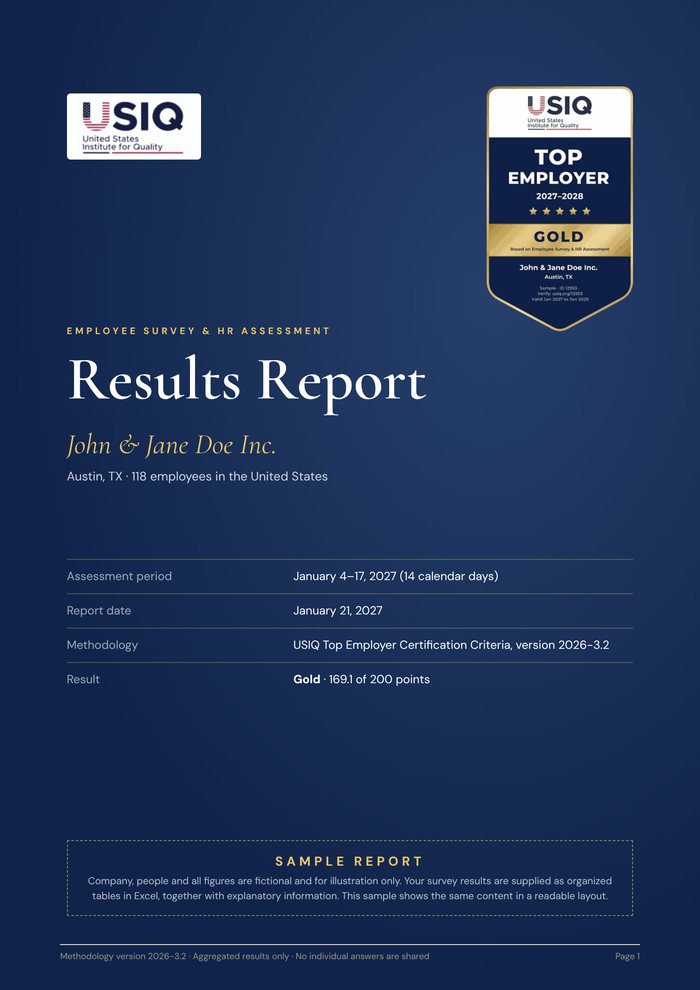
Cover of the sample Top Employer results report

What you receive

Every Criterion, With Its Level

The results report lists all 39 criteria with the evidence level and a short reviewer note, so you know exactly where points were gained and where documentation is missing.