Published criteria · explained
The Top Employer
Methodology
The Top Employer methodology in full: how the employee survey and the HR assessment are scored, who makes the decision, and what a Top Employer seal can and cannot tell candidates. No black box, no ranking, no shortcuts.
Video overview
The Method at a Glance
A short summary of the two assessment parts, the four tiers and public verification. The details follow below.

The video loads from YouTube only after you click play.
Survey and HR assessment
Employees rate their workplace in a confidential survey, and HR documents 39 criteria. Each part counts for up to 100 points.
Four tiers, one total
120 points for Certified, 140 for Silver, 160 for Gold and 180 for Platinum.
Public verification
Candidates can look up every seal on a public page. A certificate is valid for 24 months.

Developed by
The Researcher Behind the Methodology
The Top Employer methodology was developed by PhDr. Oliver Scharfenberg, MBA. His PhDr. doctoral thesis (2024) combined a market analysis of existing employer seals with a randomized experiment on how a seal changes the way applicants react to a job ad. The criteria grew out of one question from that work: what does a seal have to measure before candidates can actually rely on it?
Earlier, he served as a lay judge on the commercial chamber of the Regional Court of Berlin, hearing unfair competition cases in which misleading seals and advertising claims were part of the daily docket. Today he is CEO of Syntharis Group and author of The AI Visibility SEO & GEO Playbook.
Our Methodology
Two Perspectives, One Result
What employees experience and what the employer can document carry exactly the same weight. Neither part can make up for a weak result in the other.
Employee Survey
what employees experience
- 32 scored questions in 7 dimensions
- Confidential, aggregated results only
- All payroll employees invited
- Minimum response rate required
HR Assessment
what the employer documents
- 39 criteria in 8 areas
- Evidence on request
- Public-source consistency check
- Scored by a human reviewer
A high total alone is not enough.
Component One
The Employee Survey
Every employee on the US payroll during the survey period is invited, including part-time staff, paid apprentices and paid interns. The survey has 46 questions, 32 of them scored, and takes about 8 to 10 minutes. It stays open for 14 days and can be extended once by 7 days.
- Six-point agreement scale, normalized to 0–1 and multiplied by the item's points
- Recommendation question on a 0–10 scale, worth 6 points
- Items with fewer than five valid answers are dropped, never filled in
- Missing answers are never counted as favorable
Component Two
Inside the HR Assessment
An authorized HR or management representative answers 39 criteria online. USIQ checks the answers against public sources and may ask for documents before a human reviewer assigns the scores.
- AWork organization & processes5 criteria · 12 pts
- BLeadership & direction6 criteria · 15 pts
- CPeople development6 criteria · 15 pts
- DFlexibility & work-life integration5 criteria · 12 pts
- ECompensation, benefits & security6 criteria · 18 pts
- FCulture, fairness & inclusion5 criteria · 12 pts
- GEmployer branding & candidate experience3 criteria · 8 pts
- HTransitions & separations3 criteria · 8 pts
Six evidence levels per criterion
Area score = (average level ÷ 5) × area points. Example: an average level of 4 in a 15-point area gives 12 points. Benefits only count fully if at least 80% of the covered workforce can use them.
More about the HR assessment →Scoring & Tiers
Four Tiers, Three Hurdles Each
To reach a tier, an employer has to clear the total score, the minimum for each component and the minimum for every survey dimension. If one hurdle is missed, the highest tier with all hurdles cleared is awarded.
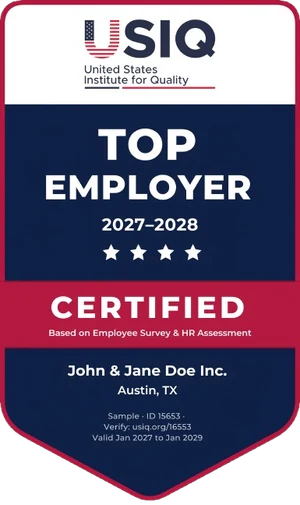
Certified
- Each component: 50
- Each dimension: 40%
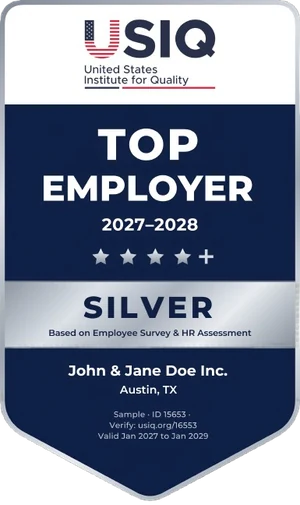
Silver
- Each component: 60
- Each dimension: 50%
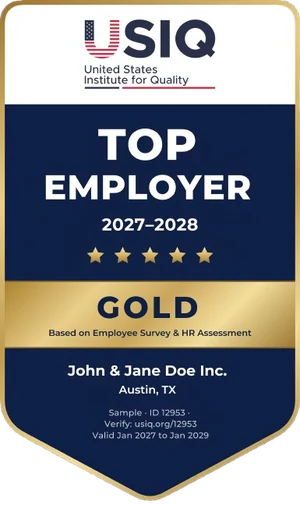
Gold
- Each component: 70
- Each dimension: 60%
Platinum
- Each component: 80
- Each dimension: 70%
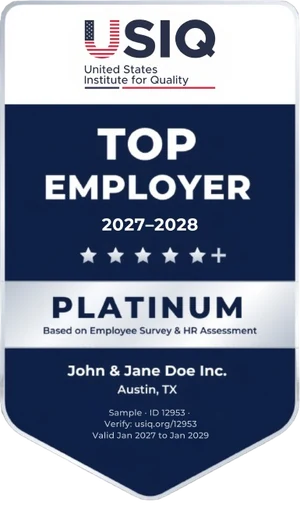
Fictional example: The survey scores 82 points and the HR assessment 80, so the total of 162 would be enough for Gold. But the weakest survey dimension only reaches 55%, below the 60% Gold minimum. The result is Silver. Scores are used at full precision, so 139.99 points do not count as 140.
Eligibility & Participation
Enough Voices for a Real Result
Employers with at least 10 US employees can apply, in any industry. A result is only issued when both the response rate and the number of responses are reached. Required numbers are rounded up, so a company with 39 employees needs 20 completed surveys.
If participation is still too low after the extension, no result is issued. The survey can then be repeated once within six months at no additional assessment charge.
| US headcount | Min. response rate | Min. responses |
|---|---|---|
| 10 – 39 | 50% | 5 |
| 40 – 249 | 30% | 12 |
| 250 – 999 | 25% | 63 |
| 1,000 + | 20% | 200 |
Review & Decision
People Decide, Not Algorithms
Scoring is separated from sales, reviewer pay never depends on awards, and payment does not buy a tier.
Questionnaire
HR answers 39 criteria, optionally with redacted documents.
Consistency Check
Public sources are reviewed. Approved AI tools may flag inconsistencies.
AI flags onlyEvidence Requests
The employer has 10 business days to provide documents.
Human Scoring
A reviewer assigns the evidence levels and points.
Second Review
A separate reviewer checks the award. USIQ decides.
Disagree with a result? Appeals are possible in writing within 30 days, without a fee, and are handled by a reviewer who was not involved in the original decision.
Scientific Foundation
What the Research Shows
In a randomized experiment for his PhDr. doctoral thesis, PhDr. Scharfenberg showed 1,093 participants the same IT job ad, once with and once without an employer seal. With the seal, the share who said they would likely apply rose from 37.96% to 53.94%.
The lesson for the methodology: a seal only works if candidates can trust it. That is why the criteria are public, the survey must be representative and every certificate can be verified.
The experiment tested a German employer seal (DIQP), not the USIQ seal. It shows how applicants react to a seal. It is not an independent validation of this scoring model.
Scharfenberg, O. (2024). Marktanalyse bestehender Gütesiegel für Arbeitgeber in Deutschland. PhDr. thesis, DTI University.
Honest Boundaries
What a Seal Says and What It Doesn’t
It does say
- Employees rated their workplace in a confidential, representative survey
- HR practices were reviewed against 39 published criteria
- A human reviewer and a second reviewer checked the result
- The certificate is current and can be verified online
It does not say
- The employer is the “best” or ranked against others
- The employer is government-approved or legally audited
- Every employee answered positively
- More applications or lower turnover are guaranteed
Questions
Methodology FAQ
Can an employer buy the certification?
No. The fee is fixed, does not change with the tier and does not buy a result. If no award is issued, USIQ keeps only the $990 exam fee and refunds the rest within 14 calendar days.
Is Platinum the top 10% of employers?
No. The tiers are fixed thresholds, not percentiles. Any number of employers can reach Platinum, and a Platinum result says nothing about how a company compares with employers that were never assessed.
Has the methodology been scientifically validated?
Not independently. The criteria draw on research on employer seals and applicant behavior, but the weights and thresholds are design choices of the program. No study has validated the scoring model itself yet, and we say so openly.
Who can see individual survey answers?
No one at your company. Employers only receive aggregated results, and no subgroup result is shown with fewer than five valid responses. Raw responses are deleted or irreversibly de-identified within 90 days after the decision.
How often is the methodology reviewed?
Once a year, and additionally after the first 100 assessments. Material changes are announced at least six months in advance.
Conversion
Begin Your Certification
Tell us about your organization. We’ll respond within 2 business days with a tailored assessment plan.