Ask the owner of a 25-person company how hiring is going and you will often hear the same answer: the jobs are there, the right people are not. In September 2026, 32% of small business owners in the NFIB jobs survey reported openings they could not fill, and 87% of those who were hiring said they saw few or no qualified applicants. Can Top Employer certification for small businesses help close that gap? It depends on what you expect from it.
Part of the problem is visibility. A candidate who has never heard of your company has little to go on besides the job ad and a handful of online reviews. Large employers can lean on their brand and on national “best employer” lists. Small businesses usually can’t, because most of those lists are not built for them.
This guide explains what a Top Employer certification can and cannot do for a small business, what a credible program should look like when you have 15 or 50 employees, and what the process involves in practice.
Why small employers struggle to be seen
Small businesses employ 45.9% of private-sector workers in the United States, according to the SBA Office of Advocacy. Yet when job seekers compare offers, they rarely compare like with like. A regional manufacturer with 40 people competes for the same machinist as a national brand with a recognizable logo, a polished careers site and a full recruiting team.
Candidates fill gaps in information with whatever signals they can find. For a well-known employer, that might be a ranking or a news story. For a small company, it is often an anonymous review written years ago. Neither tells a candidate much about what it is like to work there today.
An independent certification can close part of that gap. It gives candidates a signal that does not depend on brand recognition, as long as the certification itself is credible and open to companies of your size.
Most employer awards are built for large companies
Many of the best-known workplace recognitions set a minimum size that rules out most small businesses from the start:
- Fortune’s 100 Best Companies to Work For requires at least 1,000 employees in the U.S., according to its published methodology.
- Forbes’ lists of America’s best large and midsize employers start at 1,000 employees.
- The Top Employers Institute requires more than 250 employees in a participating country for a country certification.
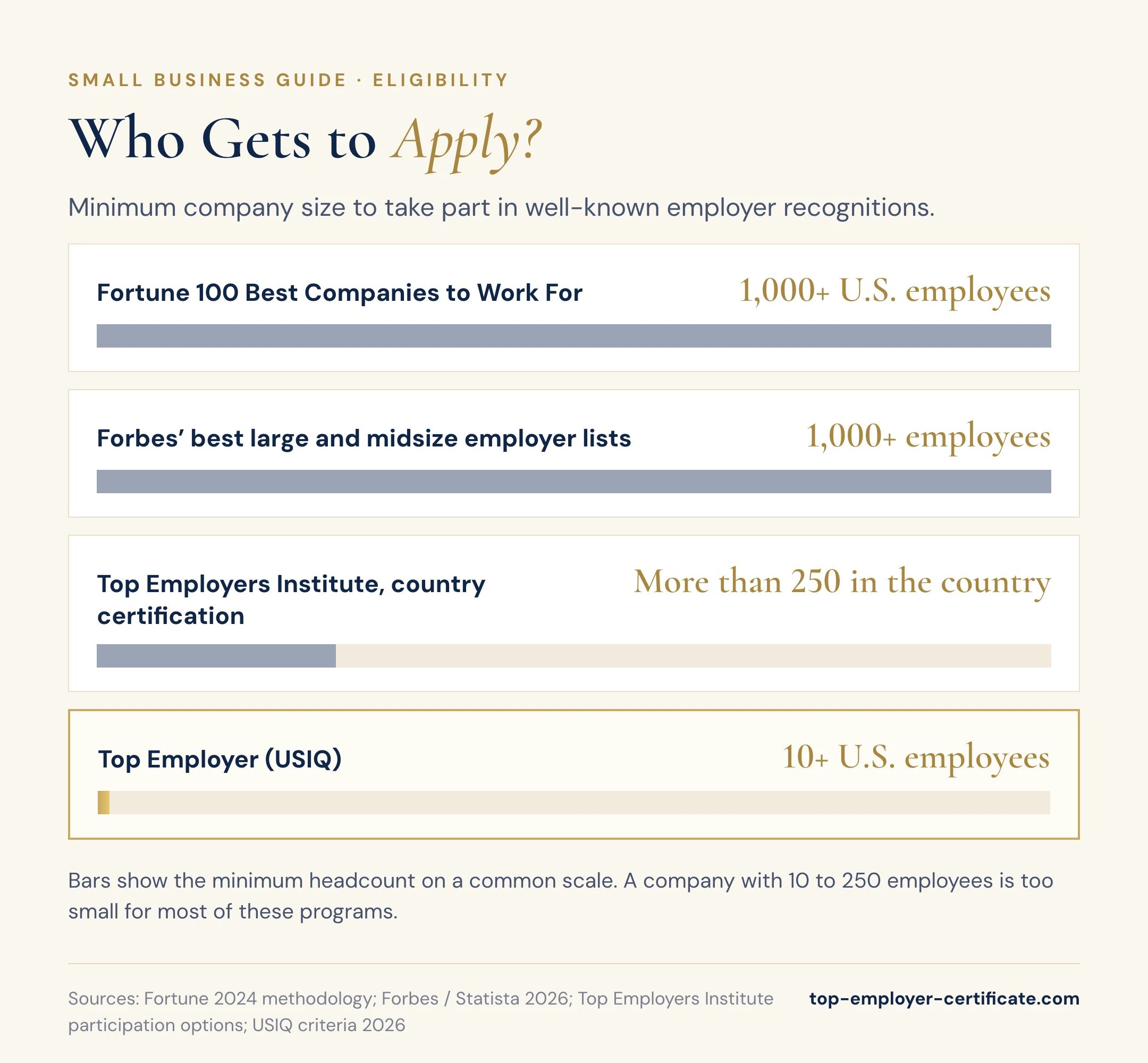
These thresholds make sense for national rankings, but they leave a gap. A company with 12, 60 or 180 employees can be an excellent place to work and still have no credible way to show it.
The opposite risk exists as well. Some “best employer” badges can be bought with little or no assessment behind them. Candidates have learned to be skeptical of those, and a badge that nobody can check may do more harm than good.
What a credible certification looks like for a small business
When you compare programs, a few questions separate a real assessment from a marketing badge:
- Are your own employees asked? A credible program surveys the people who work for you, not just HR.
- Are the criteria published? You should be able to read what is measured before you apply.
- Is there a minimum response rate? Without one, a handful of happy answers could carry the result. (Why this matters in small teams is shown in our guide to employee engagement survey questions.)
- Can candidates verify the result? A public verification page shows the tier, the scope and the dates.
- Can you fail? If every applicant passes, the seal means little. A fixed fee that does not change with the result is a good sign.
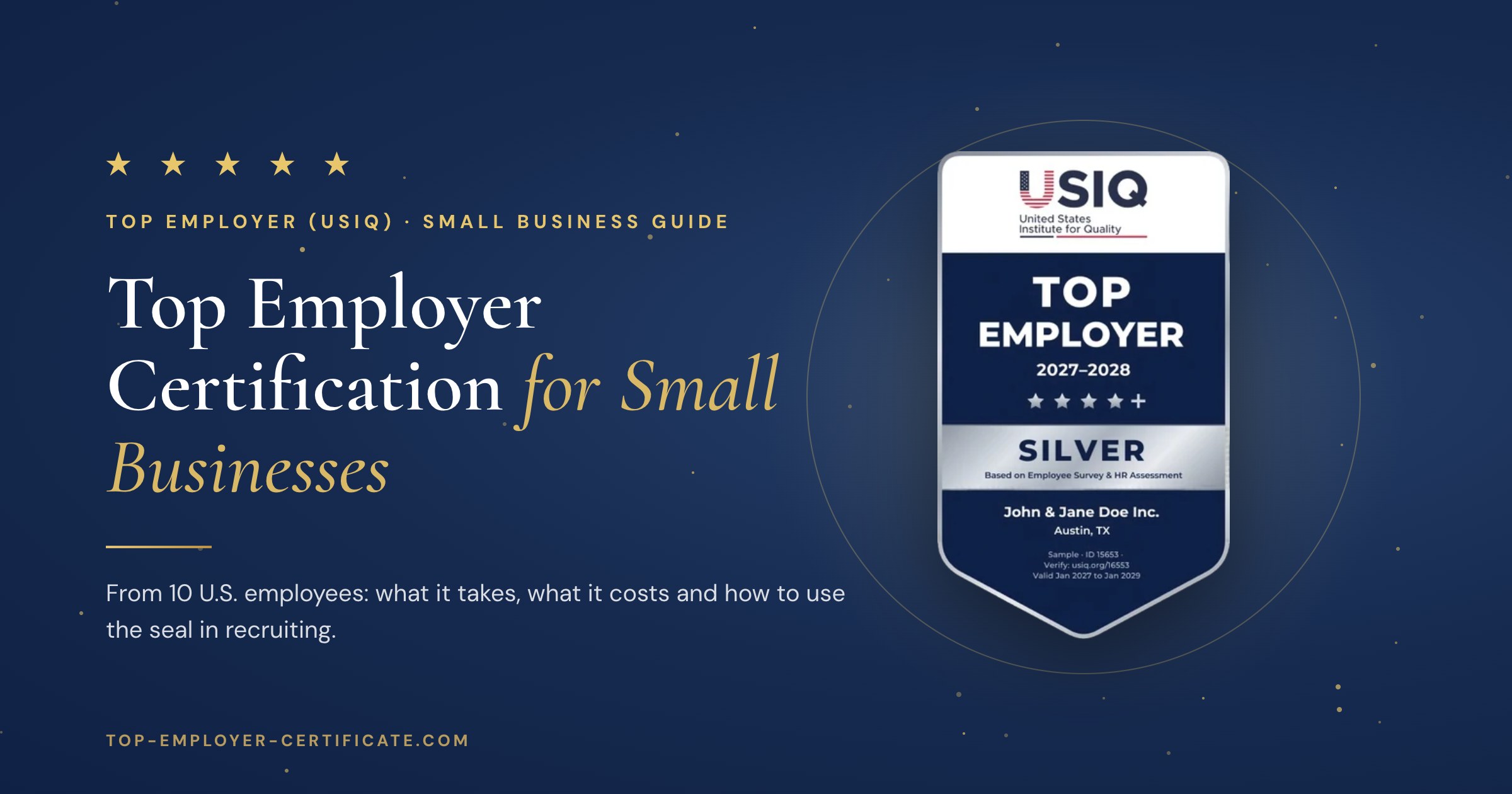
Top Employer (USIQ) was designed around these points. It is open to any employer with at least 10 employees in the United States, in any industry.
How the process works with 10 to 50 employees
The certification has two parts that count equally. Your employees answer a confidential online employee survey, and an HR or management representative completes an HR assessment with 39 criteria. Each part is worth up to 100 points. The four tiers start at 120 points (Certified) and go up to 180 points (Platinum). The full rules are explained on our methodology page.
For a small team, three details matter most:
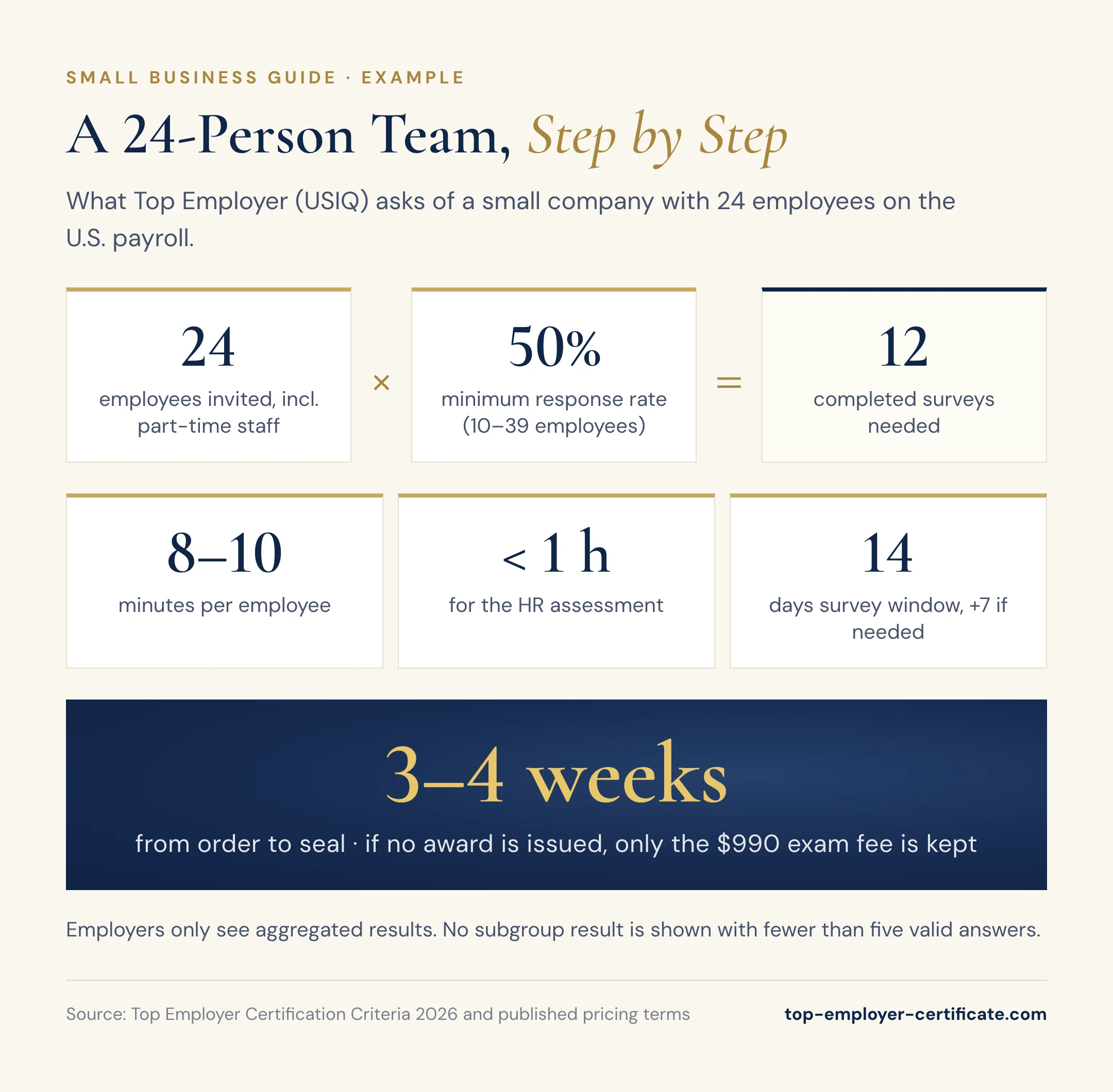
- Participation: Employers with 10 to 39 employees need at least half of their staff to respond, and at least five answers in total. In a company with 24 employees, that means 12 completed surveys.
- Confidentiality: Employers only see aggregated results, and no subgroup result is shown with fewer than five valid answers. In a small company this rule matters, because people need to trust that their answers cannot be traced back to them.
- Time: Employees need about 8 to 10 minutes for the survey, which stays open for 14 days and can be extended once by seven days. HR usually completes the assessment in less than an hour while the survey runs.
What it costs, and what happens if you don’t pass
Packages are one-time fees between $2,990 and $5,990, agreed before the assessment starts. The fee is the same whichever tier you reach, and there is no license fee for the seal during its 24-month validity. If no award is issued, USIQ keeps only the $990 exam fee and refunds the rest within 14 calendar days. You still receive your aggregated survey results. The details are on the pricing page.
For many small businesses, that last point is the real value. Even without a seal, you get structured feedback from your whole team, which is hard to collect any other way. Our sample report shows what that feedback looks like.
Is it worth it for a small company?
The honest answer: it depends on how you use it. No certification guarantees more applications or lower turnover, and you should be wary of anyone who promises that. What the research says about keeping people is covered in our guide to employee retention strategies.
What research does show is that credible signals matter to applicants. In a randomized experiment by PhDr. Oliver Scharfenberg with 1,093 participants, the share of people who said they would likely apply rose from 37.96% to 53.94% when the same job ad carried an employer seal. The study tested a German seal, so it shows how applicants react to seals in general rather than proving the effect of any single program.
For a small business, a seal tends to pay off when three things come together: you hire regularly, candidates do not yet know your name, and you are willing to act on what your employees tell you.
Preparing your team
In a small company, the survey stands or falls with trust. A few simple steps help:
- Explain why you are doing it, ideally in person or at a team meeting.
- Promise confidentiality and explain how it works: aggregated results, and no group smaller than five.
- Pick a calm 14-day window, not your busiest season.
- Make sure everyone, including part-time staff, can take part during working hours.
- Decide in advance how you will share the results and what you will do with them.
Using the seal when you are small
Small employers often get more out of a seal than large ones, because it fills a bigger gap. Place it where candidates make decisions: on your careers page, in job ads, on your LinkedIn page and in your email signature. Link it to the public verification page, name the tier and the dates, and avoid wording that suggests a ranking. Our guide on how to use your Top Employer seal goes through each channel.
Our overview of Top Employer certification in the USA covers the U.S. specifics in more detail, and our article on how a Top Employer certificate helps you attract talent shows practical places for the seal.
Frequently asked questions
What is the minimum company size for Top Employer (USIQ)?
Ten employees in the United States. Everyone on the U.S. payroll during the survey period is invited, including part-time employees, paid interns and paid apprentices.
Can a company with fewer than 10 employees apply?
No. The program is open to employers with at least 10 employees in the United States.
How long does the process take?
Usually three to four weeks from order to seal. The survey itself runs for 14 days, with one possible extension of seven days.
Do we need an HR department?
No. The HR assessment can be completed by any authorized HR or management representative, for example the owner or the office manager.

Next step
Show Candidates What Your Team Says
Top Employer (USIQ) combines a confidential employee survey with an HR assessment against 39 published criteria. One-time packages start at $2,990.
How to write engagement survey questions that hold up: what engagement means, how to word items, how many responses small teams need, U.S. legal guardrails and what to do with the results.
Which retention levers actually reduce quits? A research-based ranking with current BLS quit data, a decision table and a 90-day plan for U.S. employers with 10 to 250 staff.
Where a Top Employer seal works hardest in recruiting, how to describe it accurately and which wording to avoid once your company is certified.