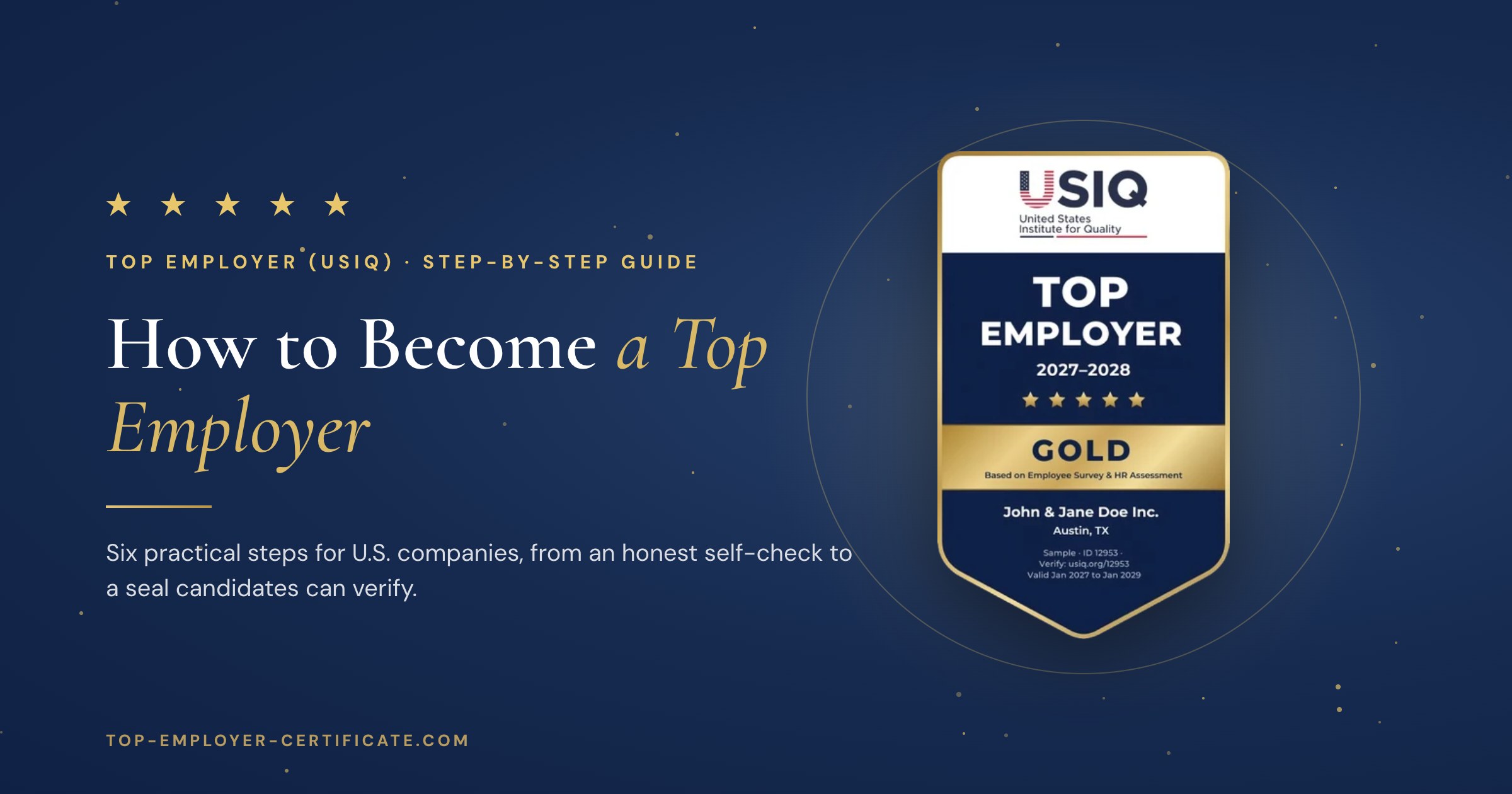
Plenty of companies call themselves a top employer. Far fewer can show why. The difference is not a better slogan but evidence: what your employees say when they are asked confidentially, and what your HR practices look like when someone checks them. Learning how to become a top employer starts with that evidence, not with the seal.
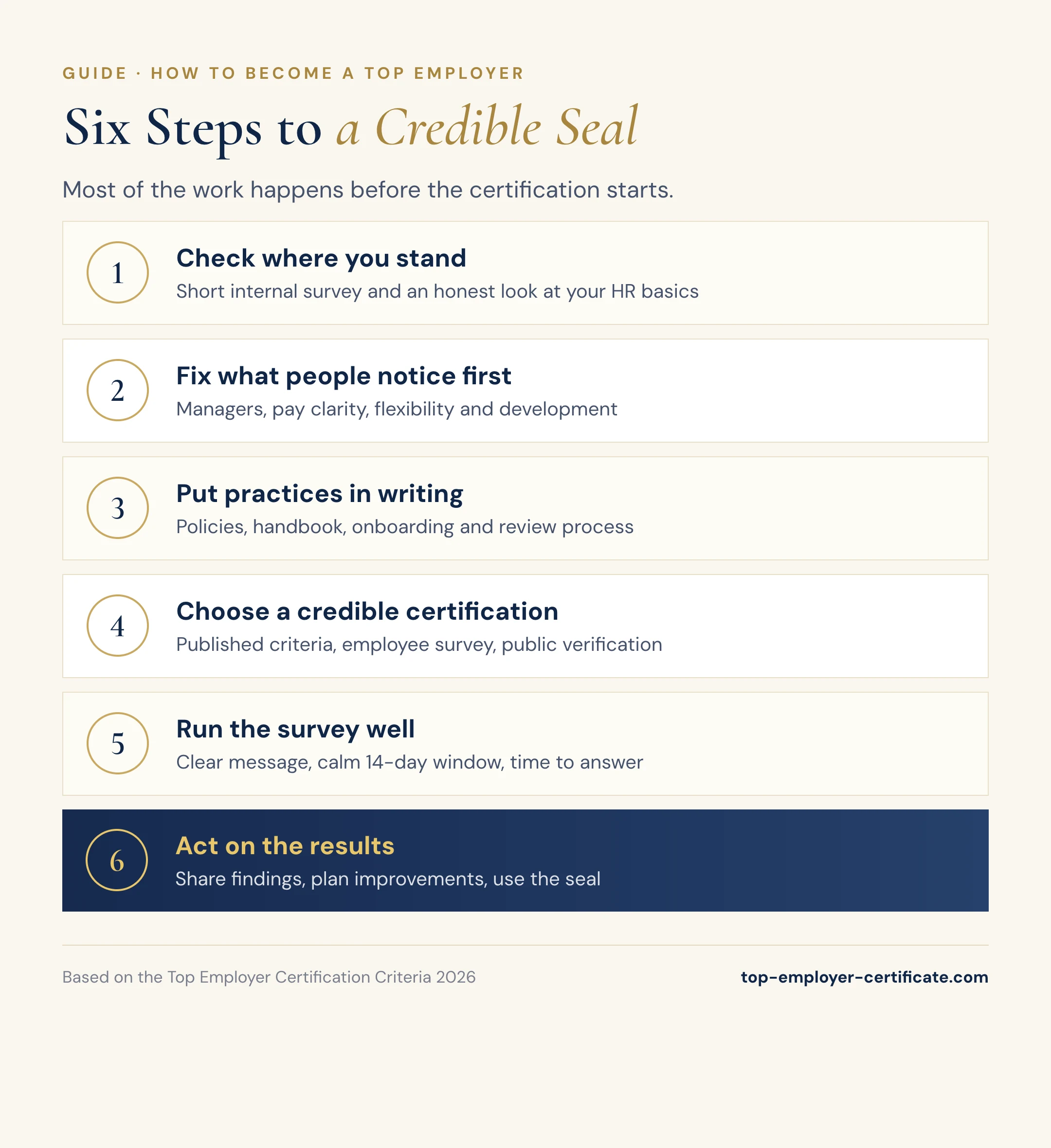
This guide walks through the six steps that usually lead from “we think we are a good place to work” to a seal that candidates can verify. Most of the work happens before any certification starts, and it is worth doing even if you never apply.
What it means to be a Top Employer
“Top employer” is not a title you can give yourself. In the formal sense, it describes an employer that has been assessed by an independent organization and met published standards for people practices and employee experience. With Top Employer (USIQ), that means two things count equally: a confidential survey of your employees and an HR assessment against 39 published criteria. Our guide What Is a Top Employer Certification? explains the background.
That is also why the path to the seal runs through your workplace, not through your marketing. If the basics are not in place, no certification will fix that, and a credible one will not hide it.
Step 1: Check where you stand
Start with an honest look inside. Two simple tools help.
First, ask your people. A short anonymous pulse survey with five or six questions often tells you more than a long internal debate: Do people know what is expected of them? Do they feel their manager supports them? Would they recommend the company to a friend?
Second, go through your HR basics area by area. The Top Employer HR assessment groups its 39 criteria into eight areas, and they make a useful checklist even before you apply:
- Work organization and processes
- Leadership and direction
- People development
- Flexibility and work-life integration
- Compensation, benefits and security
- Culture, fairness and inclusion
- Employer branding and candidate experience
- Transitions and separations
For each area, ask yourself two questions: Do we actually do this? And could we show it?
Step 2: Fix what people notice first
Employees rarely judge their workplace by the benefits brochure. They judge it by their daily experience, and that experience depends heavily on their direct manager. According to Gallup, managers account for at least 70% of the variance in team engagement, and only 29% of U.S. employees were engaged as of August 2026.
So before you polish anything else, look at the things people feel every week:
- Managers: Do they hold regular one-on-ones, give feedback and know how their team is doing?
- Pay clarity: Do people understand how pay is set and how they can grow? In many states, salary ranges in job ads are now mandatory, so internal pay logic is more visible than ever.
- Flexibility: Is it real, or does it depend on who your manager is?
- Development: Is there a plan for learning and growth, even a simple one?
These are also the topics that weigh heavily in the employee survey. Its seven dimensions include working conditions, your work, learning and development, team and climate, and your manager.
Step 3: Put your practices in writing
Many small and mid-sized companies treat people well but have little in writing. That works day to day, but it makes good practices hard to prove and easy to apply unevenly.
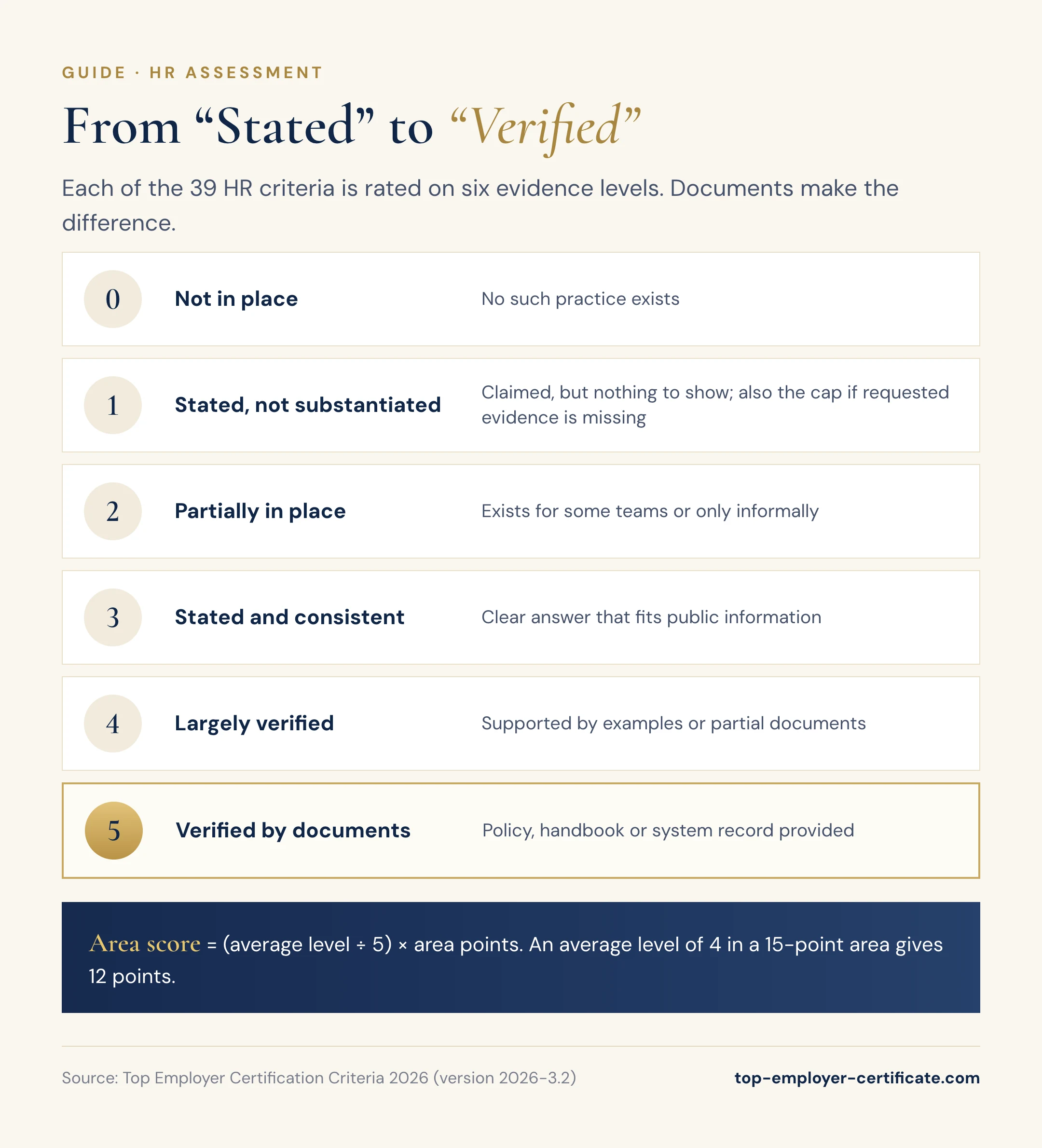
In the HR assessment, each criterion is rated on six evidence levels. A practice that is only claimed scores lower than one that is backed by a policy, a handbook or a system record. If USIQ asks for evidence and none arrives, the rating is capped at level 1.
Useful documents to prepare include an employee handbook, a written onboarding plan, a description of how performance reviews work, an overview of benefits and who is eligible, and your policies on flexible work and on leaving the company. They do not need to be long. They need to be accurate and actually used.
Step 4: Choose a credible certification
Not every badge is worth having. Before you apply anywhere, check whether your employees are surveyed, whether the criteria are published, whether there is a minimum response rate, and whether candidates can verify the result. Our guide to Top Employer certification for small businesses explains these questions in more detail.
Also check whether you are eligible at all. Many well-known programs only accept large employers. Top Employer (USIQ) is open to any employer with at least 10 employees in the United States. How the scoring works is explained on our methodology page.
Step 5: Run the employee survey well
The survey is where most certifications are won or lost, and the main risk is not bad answers but too few. A result is only issued if both the response rate and the number of responses reach the minimum for your company size.
A few things make a real difference:
- Announce the survey yourself and explain why it matters.
- Promise confidentiality and explain it: employers only see aggregated results, and no group smaller than five is shown.
- Choose a calm 14-day window. If participation is low, the survey can be extended once by seven days.
- Give frontline and shift staff time to answer during working hours. The questionnaire takes about 8 to 10 minutes.
You can read all 46 questions on our employee survey page before you start.
Step 6: Act on the results
If you reach the thresholds, you receive the seal at one of four tiers, a certificate and a public verification page. That is the moment to use it in recruiting. Our guide on how to use your Top Employer seal covers where it works best, and our overview of Top Employer certification in the USA explains the U.S. specifics.
Just as important is what you do with the feedback. Share the main results with your team, name two or three things you will improve, and follow up. Employees notice whether a survey leads anywhere, and the next survey will show it.
If you do not reach the thresholds, the effort is not wasted. You still receive your survey results and know exactly where to start. The sample report shows what those results look like. With Top Employer (USIQ), only the $990 exam fee is kept in that case and the rest is refunded, as described on the pricing page.
How long does it take?
Preparation depends on where you start. Companies with solid basics and some documentation can often apply within a few weeks. Companies that first need to put practices in writing or address management issues should plan for a few months.
The certification itself usually takes three to four weeks from order to seal: the survey runs for 14 days, the HR assessment is completed in parallel, and the review follows. If USIQ requests documents, you have 10 business days to provide them.
Frequently asked questions
Can a company call itself a Top Employer without certification?
It can describe itself as a good employer, but a seal or a title that suggests an independent assessment should only be used when one has actually taken place. Unsupported claims can mislead candidates and may raise legal issues under advertising rules.
What is the most common reason companies fall short?
Often it is not the HR policies but the employee survey: either too few people take part, or one dimension, frequently the relationship with managers, stays below the minimum for the tier.
Do we need a large HR team?
No. The HR assessment can be completed by any authorized HR or management representative, usually in less than an hour. Preparing documents takes longer if little is written down yet.
How long is the seal valid?
24 months from the date of issue. A renewal requires a new assessment, which is a good moment to measure what has changed.

Next step
Show Candidates What Your Team Says
Top Employer (USIQ) combines a confidential employee survey with an HR assessment against 39 published criteria. One-time packages start at $2,990.
How to write engagement survey questions that hold up: what engagement means, how to word items, how many responses small teams need, U.S. legal guardrails and what to do with the results.
Which retention levers actually reduce quits? A research-based ranking with current BLS quit data, a decision table and a 90-day plan for U.S. employers with 10 to 250 staff.
Where a Top Employer seal works hardest in recruiting, how to describe it accurately and which wording to avoid once your company is certified.